TLDR -Key Take Away
- Property correction is accelerating, not slowing — prestige suburbs (Point Piper, Mosman, Woollahra, Toorak) are already down 12–20% while the national figure is still only ~2%. The top leads down first; the rest follows.
- If you’re upgrading, the window is now, not “sometime in the next 12 months” — buying and selling both roughly 20% below peak locks in a bigger asset without giving anything away.
- First home buyers who bought recently under the 5% deposit scheme should throw every spare dollar at debt — it’s the highest, safest return available right now.
- The RBA isn’t the villain — Canberra’s spending and productivity failures are what’s forcing rates higher. Expect another hike within two months.
- For anyone under 40: this is a debt-reduction environment, not a leverage one. Automate it with a weekly direct debit and kill credit card debt first.
- Investment bonds are an underused way to build a tax-free home deposit or wealth for kids — Generation Life and similar providers are worth a look.
- Bond yields at 5.3% (highest since 2011) mean you can now lock in 6%+ fixed income from names like ANZ, Westpac and even Google — income today, with a capital gain kicker if rates fall.
- Imricor (ASX: IMR) remains my highest-conviction holding — the thesis hasn’t changed, hospital adoption is the catalyst to watch. I’m also personally allocating to SMECapital Fund I, a private markets fund backing entrepreneurs to buy and run SME businesses outright — a model most traditional PE can’t touch.
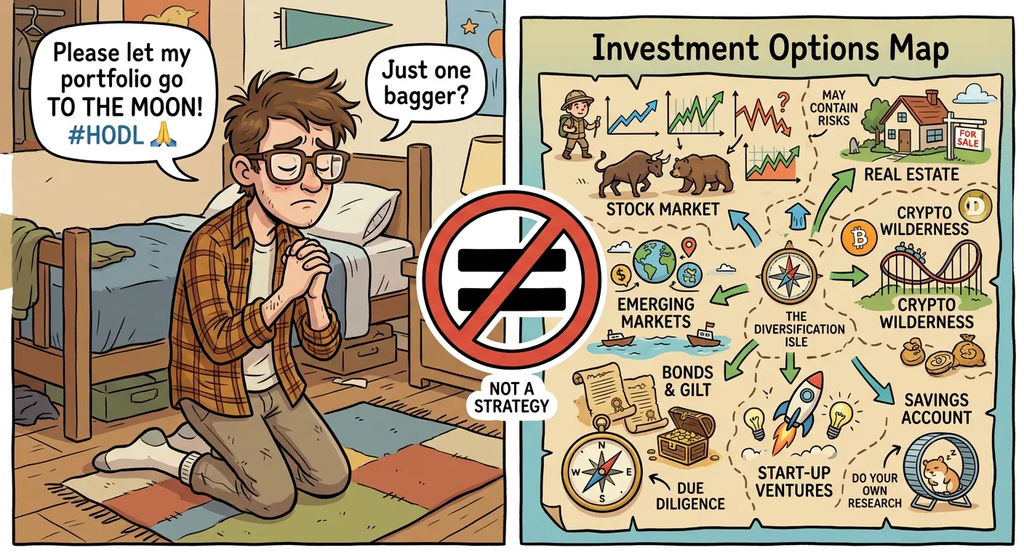
Welcome to all the new subscribers who found their way here after listening to my recent conversation with Adrian Oddi on the Oddi Poddi podcast. Adrian is also a client of mine — I act as both his adviser and accountant — and our conversation covered many of the same themes explored in this article. Coincidentally, or perhaps not, it carried exactly the same title: Hope Is Not a Strategy.
Over 84 minutes we covered the economy, interest rates, property, tax and investing, but the underlying message was simple: successful people rarely achieve their goals by hoping things work out. They build strategies, make decisions, and adapt when circumstances change.
That philosophy has guided my advice to clients for more than three decades, and it’s why I chose this title for both the podcast and this article.
If you haven’t listened to the podcast yet, I’d encourage you to do so before reading on — we discuss what’s really happening beneath the headlines and, more importantly, what investors, business owners and households should be thinking about today to position themselves for the years ahead.
Oddi Poddi on YouTube · Oddi Poddi on Apple Podcasts
The Top End Never Waits for the Average
Five weeks ago, when I made the 20% call, national dwelling prices were down only around 1.5% from their March peak, with Sydney and Melbourne down roughly 4%. Today, the official national decline is still modest — around 2%, with Sydney and Melbourne closer to 5.5%. On the surface, that doesn’t sound dramatic. But housing corrections don’t announce themselves with a crash. They begin quietly, almost imperceptibly, before gathering momentum. The important point isn’t the size of the decline so far — it’s that the direction has changed.
There’s now genuine analysis of the country’s biggest suburb-level declines, and while commentators continue to debate whether a national fall of 10% is possible, parts of Sydney and Melbourne have already experienced corrections larger than that. North Curl Curl is down 19.4% from its peak. Malabar has fallen 18.7%. Wheeler Heights is down 17.3%, Point Piper 16.5%, and South Coogee 15.6%. Even blue-chip suburbs such as Mosman, Woollahra and Toorak have recorded double-digit declines.
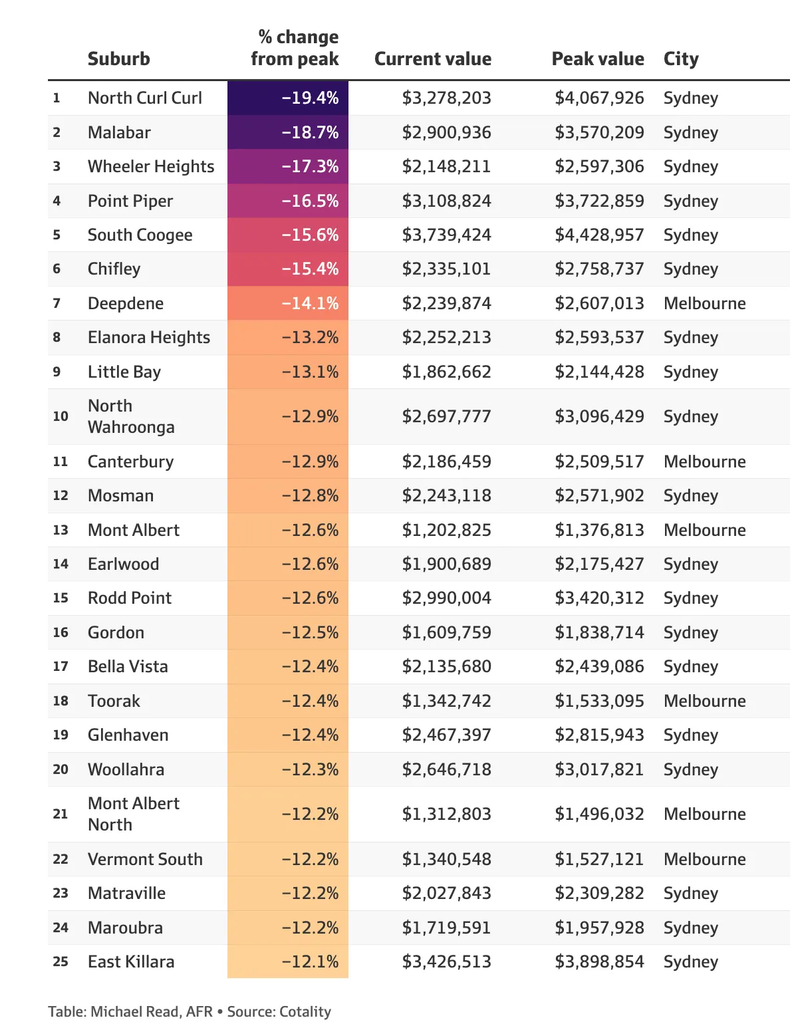
Before anyone accuses me of cherry-picking prestige suburbs, let’s acknowledge that premium markets almost always move first. The top end leads on the way up, and it leads on the way down. But that’s precisely why this data matters. These aren’t isolated declines caused by a local oversupply problem or a failed apartment development — these are some of Australia’s most tightly held and most desirable residential markets. If suburbs like Point Piper, Mosman, Woollahra and Toorak are already recording falls of 12–17%, while the official national decline is only 2%, that tells us we’re not at the end of the adjustment. We’re at the beginning.
In other words, the national figures are still catching up to what the most interest-rate-sensitive and investor-exposed parts of the market are already telling us. That’s exactly what an early-stage trend change looks like — the leaders roll over first, then the broader market follows. The question is no longer whether house prices are falling. The question is how far, and for how long.
Upgrade and Ride the Recovery
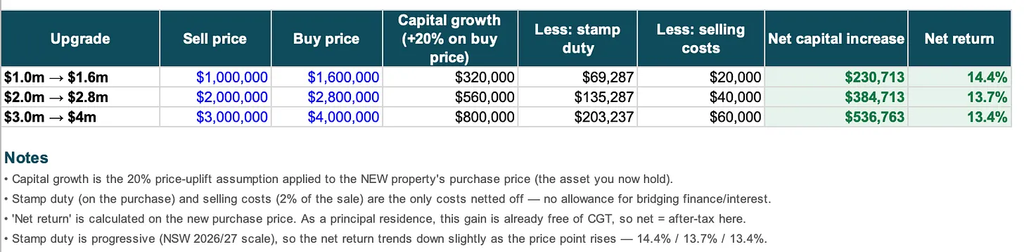
In my last post, I suggested those looking to upgrade would see good opportunities over the next 12 months. I now think that timeframe needs to come in. As the table below shows, many prestige suburbs are already down close to 20% from their peak — and on that evidence, I’d suggest we’re nearing a bottom a buy 30% below prior high and you have done well remember you make your money when you buy. i
The point worth sitting with is this: assume the home you’re buying is genuinely priced 20% below its peak — not a headline number, but the actual price you negotiate — and assume your own home sells at roughly the same 20% discount to its peak. You haven’t given anything away by transacting at the bottom of the cycle rather than the top, because both sides of the ledger moved together. What you have done is lock in a bigger asset at a genuine discount — and that part, buying and selling at a real, verifiable 20% below peak rather than guessing at the exact low, is entirely within your control.
Take a look at the table below on how you might fare when prices recover, because there’s no doubt house prices will regain their previous highs. On our modelling, an upgrader who moves in the coming year — buying and selling both 20% below peak — and then rides a 20% recovery in the new property, captures a net, after-cost return of somewhere between 13% and 14%. (Warning: check your cash flow supports an upgrade, and get advice before you act on any of this.)
A Word for First Home Buyers
Let’s not forget our first home buyers. I’ve been very critical of the 5% deposit scheme, particularly the lack of any price cap or income caps — but alas, we play the game with the rules as they are. I’m conscious that those who bought in the last 12–18 months under this scheme are now likely sitting in negative equity. The problem for this cohort is that they’ve effectively become prisoners in their own home — there’s no way around it, they’ll need to ride it out. My tip for anyone in this position: every dollar of free cash flow should go toward paying down debt. I’ve said this many times before — at a 6% interest rate, you need a 9% gross return elsewhere just to break even, and that 9% gross return carries real risk, whereas paying down debt is guaranteed and effectively risk-free.
Back to the 5% scheme itself: if you have a strong income and can buy into the market 25–30% below peak, now is the time to use it — and to accelerate your debt reduction as hard as you can once you’re in.
So how do you know you’ve actually bought well? That comes down to due diligence. My suggestion is simple: get to know the real estate agents in your target area and ask whether they’ll share recent results with you. Do this consistently and you’ll soon develop a genuine feel for where prices actually sit. Here’s a point most buyers overlook — the value of a relationship with a good agent goes well beyond politeness. The best agencies are closely tuned in to what’s recently sold, what’s quietly on the market but not publicly listed, and what’s coming up before it ever reaches the major portals.
The RBA Isn’t the Problem. Canberra Is.
Let’s get to the economy, and frankly, it’s a mess. Inflation remains stuck well above the RBA’s 2–3% target range, which means higher interest rates are becoming increasingly likely — in fact, there’s now a 90% chance of a 0.25% hike within the next two months, and with it, more pain for Australian households. The real concern is that every rate hike pushes the economy one step closer to recession, although I’d argue we’re already in one where it matters most: productivity.
The RBA is being blamed for a problem it didn’t create. It’s simply responding to the consequences of excessive government spending, policy uncertainty, and years of ignoring Australia’s worsening productivity problem. Productivity doesn’t improve because politicians announce another strategy, launch an AI framework or fund another taxpayer-backed program. It improves when businesses have the confidence to invest, innovate, employ people and grow. Instead, governments continue to add regulation, complexity and cost while expecting the private sector to somehow do more with less. The result is entirely predictable: higher interest rates, weaker economic growth and falling living standards.
Australia doesn’t have an inflation problem; it has a productivity problem. More accurately, it has a policy problem. Wealth is created through investment, productivity and enterprise — not government spending, subsidies and media announcements. Until Canberra understands that simple truth, Australians should expect higher rates, weaker growth and continued pressure on household budgets for the foreseeable future.
So, What Should You Do?
On that rather gloomy note, we have two choices. We can curl up in a ball, suck our thumb and complain about the economy — or we can roll our sleeves up and focus on the opportunities that difficult periods always create.
This section is aimed particularly at readers under 40.
If my recession call proves correct, the strategy today is surprisingly simple: accelerate debt reduction.
High inflation combined with high interest rates — what economists call stagflation — is not an environment where leverage is your friend. It’s an environment where financial resilience matters.
That probably means making some sacrifices. Fewer discretionary purchases. A cheaper holiday. Delaying the car upgrade or putting off that kitchen renovation. None of that sounds exciting. But if a recession does arrive, employment conditions can change quickly. Business owners may face lower revenues. Bonuses disappear. Hours get cut. Cash flow suddenly matters.
The purpose of reducing debt isn’t to maximise wealth tomorrow — it’s to create flexibility and reduce stress if things don’t go according to plan.
Many of you know I’m not a fan of generic financial advice. One of my favourite sayings is “barely helpful and certainly not useful.” The next time somebody gives you financial advice, ask yourself whether it’s practical enough to implement tomorrow morning.
Here’s one strategy I’ve used myself for many years: set up a direct debit from your everyday account to your mortgage or loan account every week. The amount doesn’t need to be large — that’s entirely up to you. What I’ve learned over the years is that most people spend whatever is left in their transaction account. By moving money automatically each week, you reduce the amount available to spend and increase the amount going towards debt reduction, without having to think about it.
Is it sophisticated? No. Is it largely psychology? Absolutely. Does it work? In my experience, yes.
While we’re talking about debt, let me be blunt: if you’re carrying a persistent balance on a credit card and paying interest, that should be priority number one. Credit card interest rates are some of the most expensive debt you’ll ever take on. Before investing, before speculating, before trying to pick the next hot stock, get rid of that debt.
Another strategy I’ve personally used for more than 30 years is an American Express charge card. Unlike a traditional credit card, the balance is automatically cleared from my bank account each month — no revolving debt, no interest bill. As a bonus, I’ve generally found the rewards programme far superior to most bank-issued cards.
The entire purpose of a debt-reduction strategy right now is to create a buffer. Many readers under 40 have never experienced a genuine recession as working adults — some were still at school during the Global Financial Crisis, others were too early in their careers for it to materially affect their incomes or wealth.
Recessions feel very different when you’re responsible for paying the mortgage, running the business, or supporting a family. That’s why I’m encouraging you to focus less on predicting exactly what the economy will do next, and more on ensuring your own balance sheet is ready if I’m right.
Because if the next few years turn out better than expected, you’ll still benefit from having less debt. And if they don’t, you’ll be very glad you started today.
Heard of Investment Bonds?
Since appearing on the Oddi Poddi podcast, I’ve had a surprising number of people ask me the same question: “What’s this Generation Life thing you keep talking about?”
On the episode, I mentioned that despite the disastrous May 2026 Budget and the continual tightening of tax concessions available to investors, there are still sensible, legal and tax-effective ways to build wealth. One strategy I’ve found myself discussing more frequently is the investment bond. But before we get into the technical details, there’s one group of Australians who should pay particularly close attention.
The home deposit strategy nobody talks about
For younger Australians trying to save a home deposit, investment bonds may be one of the most overlooked opportunities available today. The challenge facing first-home buyers isn’t simply saving money — it’s finding a way to grow that money faster than inflation, while avoiding the annual tax drag that comes from holding growth investments in their own name. This is where an investment bond can be extremely powerful.
Unlike superannuation, the money remains accessible if the right property opportunity comes along. Yet if the bond is held for 10 years and the contribution rules are followed, all proceeds can be withdrawn completely tax-free. That means a young investor can build exposure to Australian and international shares, benefit from long-term compounding, and potentially accumulate a deposit in a far more tax-effective structure than investing personally.
In fact, if I were in my twenties today and looking to build a home deposit over the next decade, a Generation Life investment bond would be very high on my list of options.
Parents and grandparents should also take note. Starting an investment bond for a child when they’re young could create a substantial deposit fund by the time they reach their twenties — potentially giving them a meaningful head start in an increasingly unaffordable property market.
So what exactly is an investment bond?
Investment bonds are one of Australia’s most underused wealth-building structures. They’re technically issued as life insurance policies but operate much like a professionally managed investment portfolio. Investors can choose exposure to Australian shares, international shares, property, fixed interest, cash and diversified portfolios, while all earnings are taxed internally within the bond at a maximum rate of 30%.
The practical benefit is simplicity — there’s no annual tax reporting, no capital gains calculations, and no requirement to declare yearly earnings in your personal tax return. While withdrawals can be made at any time, the real magic happens after 10 years: if the bond’s contribution rules have been followed, all withdrawals become completely tax-free, regardless of your personal tax rate.
That makes investment bonds a compelling complement to superannuation — particularly for investors who have already maximised their super contributions, are saving for long-term goals, funding children’s education costs, building a future home deposit, or looking for estate planning solutions. Another often-overlooked advantage is that investment bonds can pass directly to a nominated beneficiary outside the estate, potentially simplifying the transfer of wealth between generations.
Providers such as Generation Life, Australian Unity (Lifeplan) and Centuria Life have built increasingly sophisticated investment menus, and with superannuation contribution caps limiting how much wealth Australians can shelter each year, investment bonds are quietly re-emerging as one of the more attractive long-term wealth-building structures available.
As investors, we can complain about the changing rules, or we can adapt to them. As I’ve said before: they changed the rules, so we change the game.
Super, Bonds and a Once-in-a-Decade Yield Reset
As I wrote back in June in They Changed the Rules, We Change the Game, your superannuation fund remains one of the most powerful investment vehicles available. What’s different today is that we’ve entered an investment environment many investors have never experienced before. After years of ultra-low interest rates and near-zero bond yields, inflation has returned, and with it, higher borrowing costs, higher cash rates and significantly higher bond yields.
Australian 10-year government bond yields are now around 5.3% — the highest level since 2011. The last time yields were this high, Australia was in the middle of the mining boom and the RBA cash rate was 4.75%. By contrast, during the COVID era these same bonds yielded less than 1%. In just a few years, the investment landscape has been completely reset.
Why does this matter? Because the 10-year government bond is the benchmark against which virtually every other investment is measured. When investors can earn more than 5% from the Australian Government with minimal credit risk, the hurdle rate for shares, property and alternative assets rises. Capital is no longer forced to chase risk simply to generate income.
This doesn’t mean abandoning growth assets — it means being more selective and recognising that defensive assets can once again play a meaningful role in generating returns. For the first time in more than a decade, investors can build portfolios that deliver attractive income without relying solely on capital growth or taking excessive risk.
Right now, you can lock in investment-grade fixed income yields of 6%+ from names everyone recognises — ANZ, Westpac, even Google (Alphabet). That’s not a “chase yield in some dodgy corner of the market” trade — these are some of the largest, most creditworthy borrowers on the planet, and it’s a level of income that simply hasn’t been on offer for most of the last decade. Buy the note, and you know exactly what hits your account every six months, regardless of what shares or property are doing in the meantime.
Here’s the part most people miss: it’s not just about the income. Bond prices move inversely to yields, so if you buy a 6%+ note today and the cycle turns — central banks start cutting as inflation cools — new bonds coming to market will carry lower coupons than yours. Your existing note, still paying that higher fixed rate, suddenly looks a lot more attractive by comparison, and that pushes its price up. So you’re banking an attractive income stream today, while also positioning for a genuine capital gain kicker if and when rates fall. It’s a “have your cake and eat it too” setup that cash and term deposits just can’t match — you get paid well to wait, and you’re holding the winning ticket if the cycle breaks your way.
Imricor Remains My Highest Conviction Investment
For regular readers, this won’t come as a surprise. Imricor Medical Systems (ASX: IMR) remains my largest individual investment holding by a considerable margin.
I’ve been writing about Imricor since the share price was around 50 cents, and despite the strong performance to date, my long-term view hasn’t changed — if anything, I believe the business has the potential to be worth many multiples of its current valuation over the years ahead.
The most common question I get is why the share price isn’t still climbing every week. The answer is simple: investors got used to the extraordinary re-rating that happened as the market moved from ignoring the company to finally recognising its potential. That phase was never going to continue indefinitely. Today’s valuation is more realistic, but the underlying opportunity is arguably even stronger.
Imricor is attempting to fundamentally change how cardiac, and eventually other interventional, procedures are performed — moving hospitals from fluoroscopy and X-ray guidance into the MRI environment, eliminating radiation exposure while providing superior imaging. That’s a genuine change to the standard of care, not an incremental product improvement, which is exactly why adoption takes time: budgets, training and clinical trust all move deliberately in healthcare. The economics stack up too — cardiac procedures are among the most profitable services a hospital offers, and Imricor’s technology, backed by imaging leaders Siemens and Philips, lets hospitals run a radiation-free interventional suite while keeping a fully functional diagnostic MRI asset.
IMR remains range-bound between roughly $1.80 and $2.10. In my view, the catalyst that breaks it out isn’t further FDA approvals — most of the key regulatory milestones are already behind the platform — it’s hospital adoption. Every new centre that commits to an Imricor lab, and every successful installation, moves the industry one step closer to a new standard of care. That won’t happen overnight, but our job as investors isn’t to predict next month’s share price — it’s to identify exceptional businesses and give management the time to execute.
For me, nothing has changed. Imricor remains my highest conviction investment.
Backing SME Capital Fund 1
On the topic of high-conviction opportunities, I’ll also flag one closer to home. I’ll be personally allocating to SMECapital Fund I, run by Five V Capital.
What makes this different from most private equity funds is the model itself. Traditional PE targets larger, professionally managed businesses with $50m+ revenue — scale that supports leverage and an existing management team to partner with. SMECapital Fund I does the opposite. It backs individual “acquisition entrepreneurs” to buy 100% of established SME businesses — typically $10–50m in revenue — and step in as CEO themselves. It’s a model known as Entrepreneurship Through Acquisition (ETA), and it targets exactly the pool of high-quality, founder-led businesses that fall outside typical PE criteria: too small for institutional buyers, too good to be ignored. Four acquisitions are already completed within the fund, at a blended entry multiple of 4.3x EBITDA — well below what you’d pay at the mid-market or large-cap end of PE.
It’s also backed by one of the best in the business. Charlie Lanchester sits on the Investment Committee — former Managing Director at BlackRock, former Chief Investment Officer at Hearts & Minds, and more than 30 years in fund management with deep experience in Australian equities. That’s the calibre of oversight behind the capital.
None of this is a substitute for advice tailored to your own situation — debt reduction, investment bonds, super and direct share exposure all play out differently depending on where you sit. The same goes for SMECapital Fund I: it isn’t for everyone, and it carries the illiquidity and risk you’d expect from a private markets fund. But if anything in this piece struck a chord — whether that’s your own financial position or finding out more about the fund I’m personally backing — reach out. I read every reply to this newsletter, and I’m always happy to have the conversation.